Skip to content
Key Takeaways
– Follow IES/ANSI RP-6 guidelines for compliance.
– Each sport and competition level has specific lighting standards for brightness (foot-candles), uniformity, and glare control.
– Use qualified lighting designers for custom layouts
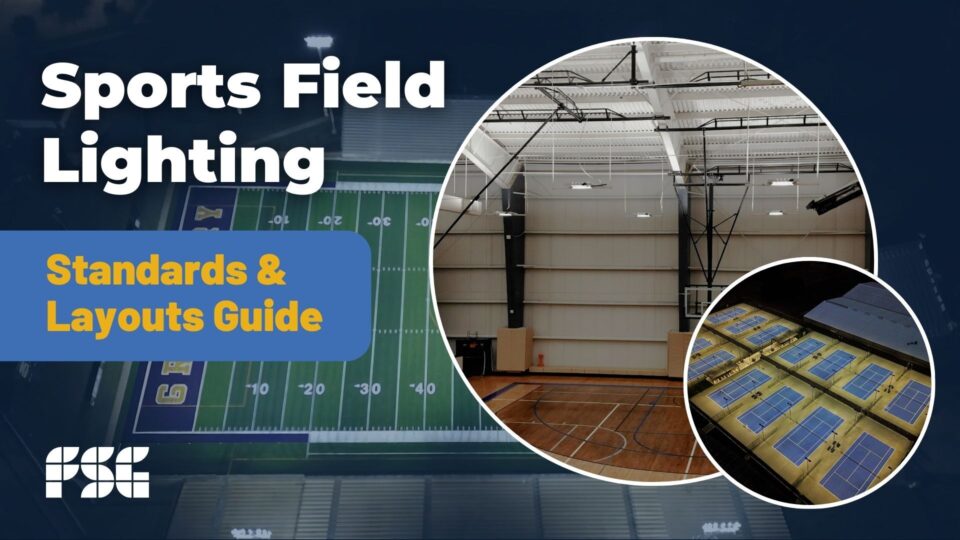
Lighting is a critical component of any sports facility. It impacts safety, athletic performance, and the overall experience for spectators.
Whether you’re upgrading an existing system or starting from scratch, this guide outlines the most relevant 2025 standards and practical design considerations to help you choose the best lighting strategy for your field.
Understanding IES Lighting Standards
The Illuminating Engineering Society (IES) sets the benchmark for lighting design across all types of facilities, including sports venues. IES standards help ensure consistent visibility, uniformity, and safety, while also considering energy efficiency and visual comfort.
IES standards typically address the following areas:
- Recommended Illuminance (lux/foot-candle) Levels based on the level of play (recreational, amateur, televised/professional). Foot-candle (fc) is the U.S. measurement, lux is the international measurement. Learn more about what is a foot-candle.
- Uniformity Ratios to minimize hot spots or dark zones across the field.
- Glare Control Metrics to ensure player and spectator comfort.
- Color Rendering Index (CRI) standards to ensure accurate color visibility, especially important in televised or competitive environments. Learn more about CRI.
As of 2025, the ANSI/IES RP-6 guidelines remain the most widely referenced document for sports field lighting in North America. Facilities looking to stay compliant and competitive should consult these guidelines during the design or upgrade process.
Why Sports Lighting Standards Matter
Safety and Visibility
Well-designed lighting reduces the risk of injury by enhancing depth perception and clarity during fast-paced play. Whether indoors or out, consistent illumination across the field or court is essential for both players and spectators.
Compliance with IES Guidelines
The Illuminating Engineering Society (IES) provides widely recognized standards for sports lighting. Adhering to these ensures your facility meets industry expectations for brightness, uniformity, glare control, and energy efficiency.
Energy and Cost Efficiency
Modern LED systems offer high performance with lower energy usage. They also reduce maintenance demands and improve lifespan, making them a smart investment for facilities looking to lower operational costs while maintaining high lighting standards.
Sport Lighting Requirements Vary by Sport
Lighting your sports facility isn’t as simple as flipping a switch. Different sports require different lighting levels, depending on things like field size, ball speed, and level of play.
In the below clip from the sports lighting episode of our FSG Podcast, we break down how lighting standards vary for football, baseball, and tennis — and why meeting those specs matters for both players and fans.
What are the Most Important Sports Lighting Concepts?
Key Terms to Understand
- Foot-candles (fc) vs. Lumens: Foot-candles measure illumination over a surface area, while lumens measure total light output. Foot-candles are the preferred measurement in field design.
- Uniformity Ratio: Indicates how evenly light is distributed. A lower ratio, such as 1.5:1, means better uniformity.
- Glare Rating: Measured using Glare Rating (GR) or Unified Glare Rating (UGR), this helps ensure player and spectator comfort.
- Mounting Height: Affects light spread and shadow control. Pole height plays a significant role in uniform coverage.
What are the IES Light Level Standards by Sport?
Table: IES Lighting Recommendations by Sport and Level of Play
| Sport & Area | Class I (Professional & Broadcast) | Class II (College & Minor League) | Class III (High School Recreational) | Class IV (Training & Leisure) |
|---|---|---|---|---|
| Baseball / Softball (Outdoor) | 100 fc | 70 fc | 50 fc | 30 fc |
| Football (Outdoor) | 100 fc | 50 fc | 30 fc | 20 fc |
| Soccer (Outdoor) | 75 fc | 50 fc | 30 fc | 20 fc |
| Tennis (Outdoor) | 100 fc | 75 fc | 50 fc | 30 fc |
| Pickleball (Outdoor) | 75 fc | 50 fc | 30 fc | 20 fc |
| Basketball (Outdoor) | 100 fc | 75 fc | 50 fc | 30 fc |
| Basketball (Indoor) | 100 fc | 75 fc | 50 fc | 30 fc |
| Ice Hockey (Indoor) | 100 fc | 70 fc | 50 fc | 30 fc |
| Track & Field (Outdoor) | 50 fc | 30 fc | 20 fc | 10 fc |
| Field Hockey (Outdoor) | 100 fc | 70 fc | 50 fc | 30 fc |
| Lacrosse (Outdoor) | 70 fc | 50 fc | 30 fc | 20 fc |
| Fitness Centers / Gyms (Indoor) | 50–75 fc | — | — | 30–50 fc |
Sport-Specific Lighting Design and Layouts
Tennis Court Lighting
IES Standard for Tennis Courts: 100 foot-candles for professional, 75 foot-candles for college, 50 foot-candles for high school, 30 foot-candles for recreational.
Tennis court lighting requires clear visibility of a fast-moving ball across all areas of the court. Light should be evenly distributed to minimize shadows, and glare must be controlled to prevent visual discomfort.
- Required Foot-candle Levels: 30 to 50 fc for recreational, 75+fc for competitive/professional.
- Mounting Height: Typically 20 to 40 feet.
- Typical Pole Placement: Two to eight poles, positioned outside the playing area.
- Special Considerations: Use fixtures with shielding to control glare and avoid light trespass, especially in residential zones.


Football Field Lighting Standards
IES Standard for Football Fields: 100 foot-candles for professional, 50 foot-candles for college, 30 foot-candles for high school, 20 foot-candles for recreational.
Football fields demand high uniformity and glare control to ensure safety at all player positions. Since the game is dynamic and directional, asymmetrical lighting may be used.
- Required Foot-candle Levels: 20–50 fc for recreational/non-broadcast, 50-100 fc competitive/professional or broadcast.
- Pole Height: 50 to 70 feet.
- Typical Pole Placement: 4 to 6 poles on each side of the field.
- Design Tips: Aim fixtures to eliminate shadows in the end zones and provide facial visibility for athletes.


Soccer Field Lighting Standards
IES Standard for Soccer Fields: 75 foot-candles for professional, 50 foot-candles for college, 30 foot-candles for high school, 20 foot-candles for recreational.
Lighting design for soccer fields depends on the level of play. The layout should prioritize uniformity, especially across the goal areas and sidelines.
- Required Foot-candle Levels: 20–30 fc for recreational/non-broadcast, 50-75+ fc competitive/professional or broadcast.
- Pole Height: 30 to 75 feet.
- Pole Placement: Typically, 6 to 8 poles placed along the sidelines.
- Challenges: Large field size requires careful beam spread to prevent uneven patches.
Baseball Field Lighting Standards
IES Standard for Baseball Fields: 100 foot-candles for professional, 75 foot-candles for college, 50 foot-candles for high school, 30 foot-candles for recreational.
Baseball field lighting is more complex due to different visual needs in the infield vs. the outfield. Higher light levels are needed at the pitcher’s mound and batter’s box. Pole eight varies between competition levels.
- Foot-candle Requirements: 20–50 fc for recreational/non-broadcast, 70-100 fc for competitive/professional or broadcast.
- Pole Configuration: Often 6–8 poles, with more concentration near the infield.
- Design Considerations: Asymmetrical lighting and cross-aiming to reduce shadows from fly balls.

Pickleball Court Lighting Standards
Pickleball is gaining popularity in urban and residential areas, where light spill is a concern. Designs should focus on precise beam control.
- Required Foot-candle Levels: 20–30 fc for recreational/non-broadcast, 50-75 fc for competitive/professional or broadcast.
- Pole Height: 18 to 25 feet.
- Fixture Tips: Use cutoff optics and shielding to reduce glare and comply with local dark-sky ordinances.

Source: FSG Media
Basketball & Gymnasium Lighting Standards
Indoor basketball courts demand even lighting with minimal glare for both players and fans. High CRI lighting is important for clarity during televised games.
- Required Foot-candle Levels: 30–50 fc for recreational/non-broadcast, 75-100 fc for competitive/professional or broadcast.
- Mounting Method: Ceiling or truss mounted; layout should prevent direct glare into players’ eyes.
- Special Note: Wall color and reflectivity impact light performance.
Fitness Center Lighting Standards
Fitness centers involve varied activity zones. Lighting should support concentration, movement, and comfort.
- Required Foot-candle Levels: 30 to 75 fc, depending on use.
- Design Zones: Highlight cardio equipment, free weight areas, and class rooms differently.
- Recommended Features: Indirect lighting, glare control, and ambient dimming options.
Pole Quantity, Height, and Placement
Pole placement significantly impacts lighting performance. While the quantity of poles depends on the field size, light output, and fixture quality, these are general guidelines:
- Standard Pole Heights: 20 to 70 feet for lower levels of competition, and 50 to 100+ feet for higher levels of sport. Depends on the sport and venue size.
- Distance Between Poles: Usually 60 to 100 feet, adjusted based on beam spread.
- Positioning: Poles are best placed along the sidelines or behind baselines to avoid interfering with gameplay.
Design Considerations:
- Taller poles allow for wider light spread but may increase spill risk without proper shielding
- Shorter poles require more fixtures to cover the same area evenly
- Use twin-mount or cross-aiming strategies to minimize shadows and improve light distribution
Indoor vs. Outdoor Sports Lighting
Indoor facilities require consideration of wall reflectivity, ceiling height, and mechanical obstructions (like HVAC). Outdoor sports need to factor in environmental challenges like wind, weatherproofing, and surrounding structures.
Key differences include:
- Outdoor: Requires IP65+ rating, dark-sky compliance, and beam cutoff to minimize spill
- Indoor: Must address bouncing light and uniformity across vertical surfaces
Smart Lighting Controls and Automation
Modern sports facilities often use smart lighting systems for better control and efficiency:
- Scheduling & Automation: Control light output based on event time or activity type
- Zoning: Adjust lighting levels by area (e.g., warm-up zones vs. main courts)
- Remote Access: Manage systems through mobile apps or facility software
- Energy Optimization: Dimming capabilities help lower costs during off-peak hours
How Long Do LED Sports Fields Lights Last?
LED sports lights are engineered for durability and low upkeep:
- Lifespan: 50,000 to 100,000 hours, depending on use and quality
- Maintenance Tips: Clean lenses periodically, check mounts, and replace failed drivers promptly
- Other Considerations: Ensure surge protection and weatherproof housings for outdoor installations
Common Pitfalls to Avoid
- Overlighting the field, leading to glare and energy waste
- Poor uniformity due to incorrect aiming or mounting height
- Inadequate light in critical zones (e.g., goal areas or center court)
- Ignoring local lighting ordinances, especially near residential areas
Choosing the Right Layout
Each facility has unique needs based on sport, level of play, location, and budget. A custom photometric layout ensures proper coverage, minimizes shadows, and helps meet compliance goals. Always use a qualified lighting designer with access to professional modeling tools.
Final Considerations
Lighting is more than a fixture count. It’s a strategic investment that affects athlete performance, safety, and operational costs. Partnering with a team experienced in photometric design and IES standards is the best way to future-proof your facility.
If you’re ready to plan a system that meets today’s standards and tomorrow’s demands, we’re here to help. Contact us today to schedule a lighting consultation.
Authored by Andrew Ghilino
Expert reviewed by Bernie Erickson, LC, CLEP, CLMC, CMO Emeritus/Key Accounts at Facility Solutions Group.